
You return to a padel court after a match that unsettled you. The distance to your partner is familiar. The ball meets your racket once. It is not proof that confidence has returned, and it is a contact you made.
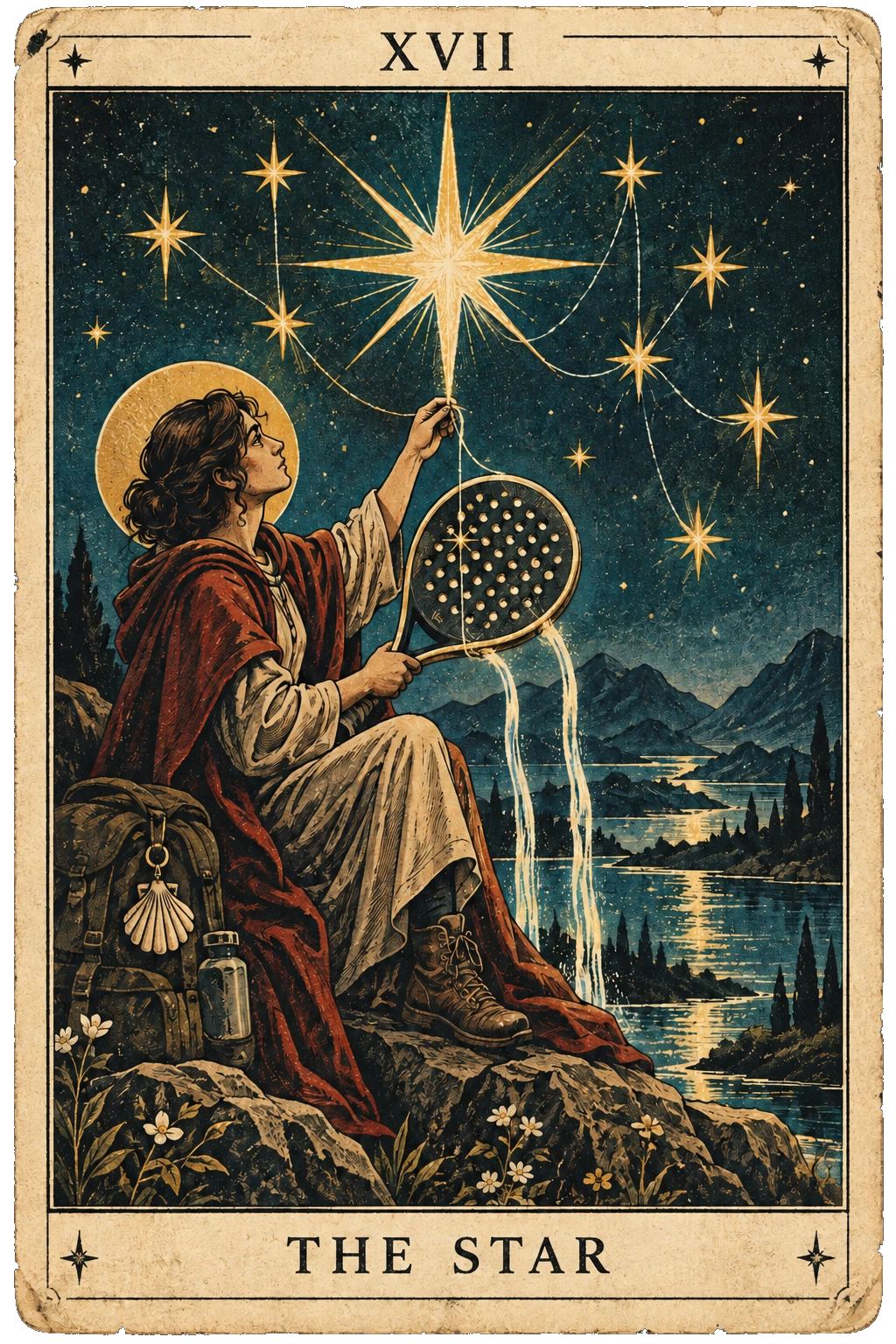
In the Star's card, a figure sits without armour beside open water. One large light gives orientation, smaller ones remain scattered across the sky, and the racket seems ready to receive rather than strike brightness away. Water moves into land and pool. The Tower's walls have not grown back around her.
Hope can become an unfair demand when someone is still living with the fall. “You'll be fine next time” may close the conversation that mattered. The Star permits a smaller sign: a partner who still wants to play, one clean return, a wish to take the racket out of its bag. None is obliged to forecast recovery. Each can make an honest next act possible.
Perhaps you agree to play one easy evening rather than enter another pressured match. Perhaps you tell your partner you want to return but are not ready to laugh about the last game. Smallness is not a failure of ambition here. An act that can actually be taken, and perhaps repeated, is a stronger form of hope than a promise about the player you will someday become.
There is a tempting brighter picture in which you wait for the fully confident player you intend to become. You may even tell others that all is well to spare them and yourself disappointment. The picture dissolves at the first ordinary miss. A light that helps you move is more useful than a portrait of already having arrived.
The Tale of the Star remembers a child, a damaged racket and a cracked cup. They do not repair a whole court alone; with other hands, they begin something the court can hold. What action could you repeat without requiring it to redeem everything that happened before?