
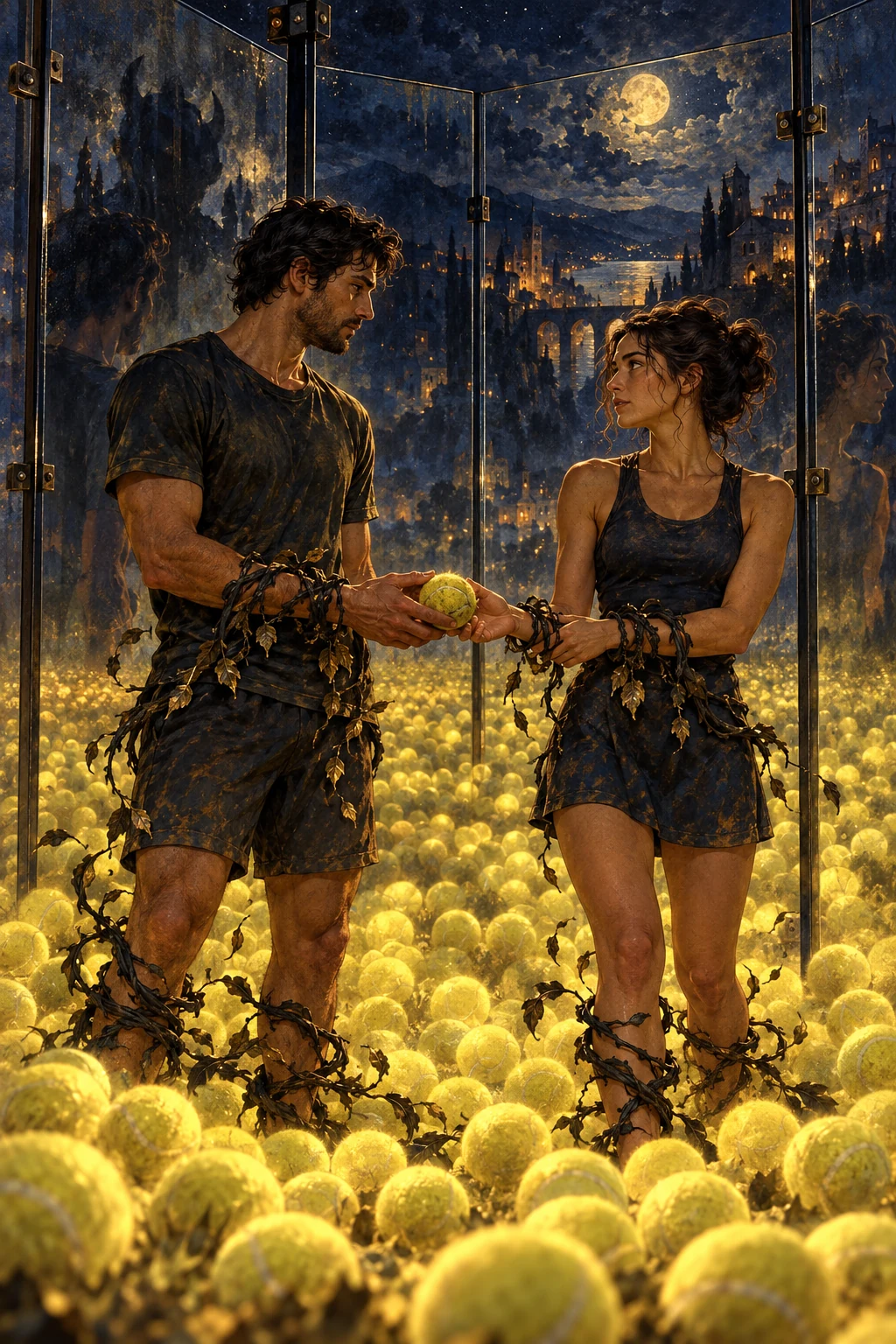
The brightest ball pulsed just beyond their hands. Both players reached for it, though the vines around their ankles had loosened enough for them to leave. For a moment they saw each other reaching. Then they laughed, uneasy at how quickly the field had called them back.
They had entered the field beyond the southern glass to find a ball that would guarantee victory. Every perfect one seemed to offer something more: never miss again, silence a critic, prove a partner wrong, recover the first win. Whenever they picked one up, it became an ordinary ball and another gleamed farther away. By nightfall vines had reached their wrists.
A horned shadow gathered in the glass. They asked it to release them. It said it had tied no knot; it had only learned which promise made them reach. One player denied wanting anything and pulled until the vines cut deeper. The other examined the first loop. It was loose. She said aloud what she had wanted the wins to do: make it impossible for anyone to leave her. The vine weakened.
Her partner named his own bargain. If he could never be at fault, he thought, no one could make him feel small. His vine loosened too. That was when the brightest ball began to pulse and both reached again. Their laughter did not make the desire disappear. It meant they had noticed it in time to choose.
They left with one scuffed ball for practice. The shadow followed as a smaller reflection in the glass. At the gate they marked a warning about the next thing one feels one must have. They did not claim the field could no longer call to them.