The rival match is still days away, yet one point has already begun in your head. You imagine the shot that will settle a grievance from last time. By the time you arrive at the padel court, the ball is being asked to prove something about you that no ball can prove.
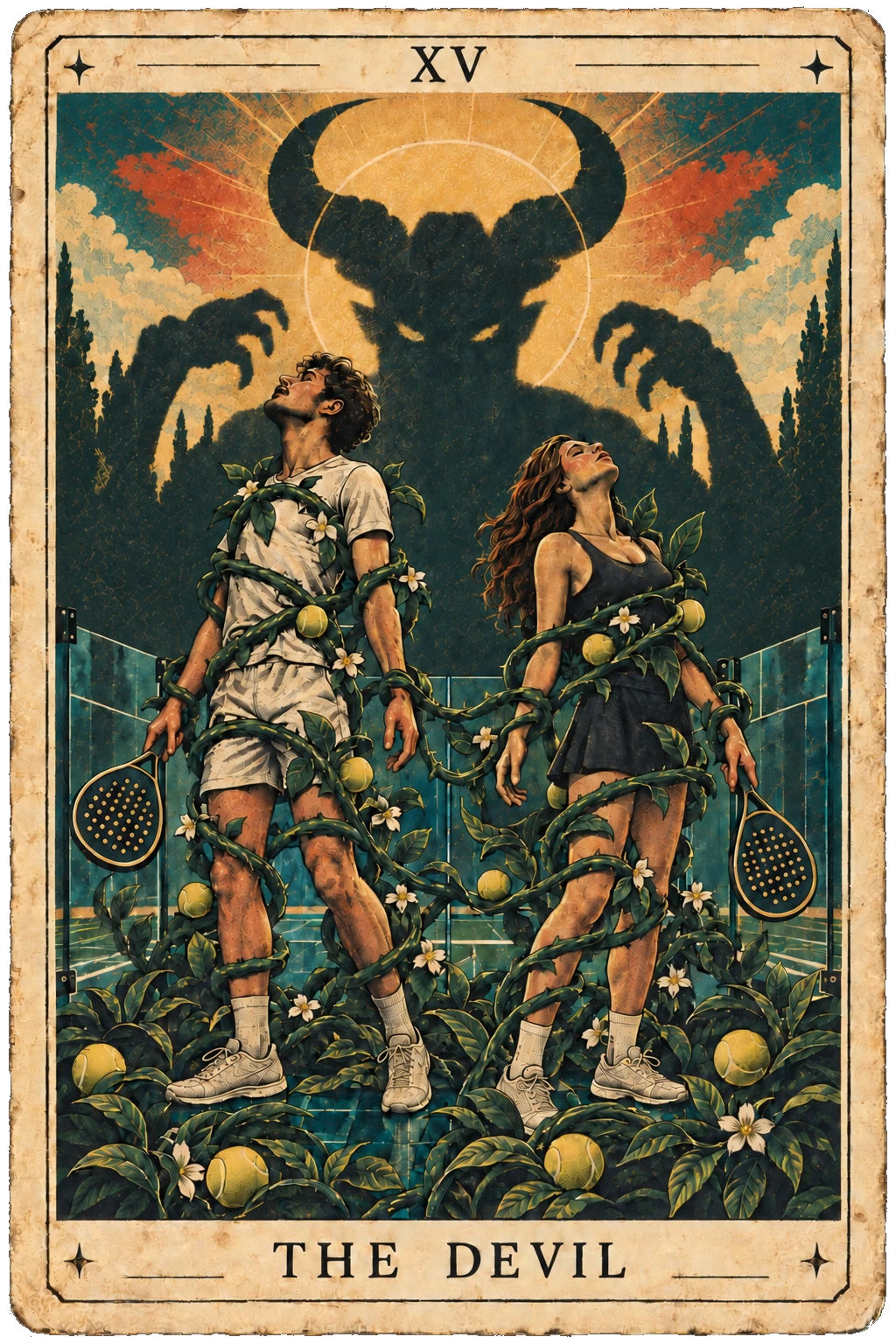
Two figures stand apart in the Devil's card, looking upward rather than toward one another. Yellow balls crowd the ground. Vines bind bodies and equipment beneath a horned shape that rises behind them; the bond is part of the scene they are participating in, not an enemy that has arrived from elsewhere. The rackets are still in their hands.
There is nothing shameful about wanting to win or caring about a rivalry. The hook is the extra bargain: the result must establish your worth, a highlight must compensate for an old embarrassment, a partner must validate the version of yourself you have brought to court. You can notice how often your attention returns to that demand without pretending the desire will vanish.
Then a miss arrives. Self-attack tightens the next stroke; the next mistake seems to justify the attack. Or each player blames the other while both keep feeding the pattern. Recognition offers a narrow but real freedom: to notice what the bargain demands and try a choice it would usually prevent. Seeing the hook does not mean it has ceased to pull.
Shame can make the pattern seem private even when it is affecting both players. One may begin choosing safer balls to avoid the other's reaction; the other reads that caution as lack of belief. Naming the loop can give the pair something to address together without appointing either person as its monster.
The Lovers asked how two people choose a bond and remain themselves. Here attachment has begun to write the point in advance. The vines can be seen before the racket has left the player's hand.