
The missed ball belongs to one racket. The next point belongs to the pair. Between those two facts lies a choice that doubles players make again and again, sometimes without speaking.
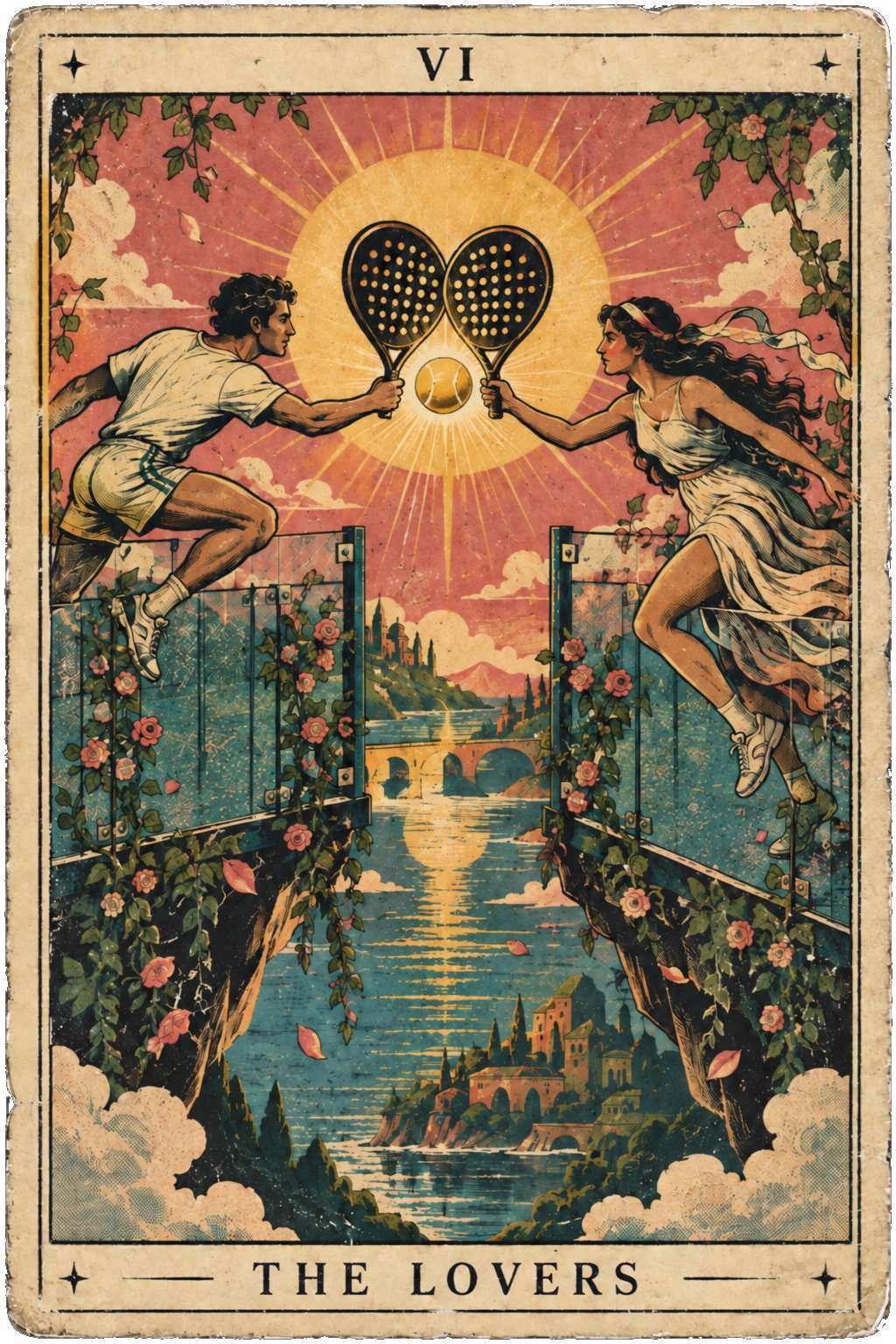
On the Lovers card, two figures approach from opposite sides of a central divide. Their rackets and gestures make a meeting possible without erasing the space each has crossed. The image is concerned with alliance, not simply with romance or a promise that harmony will last.
You can stand on the same side of a padel court and still be playing two private games. One person calls for a slower point while the other keeps trying to finish it. A partner covers a difficult return; the other interprets it as a judgement on their ability. Choosing together begins when both can name what they are trying to make, and what each is able to give.
Sometimes the choice is made at 30-all, with too little time for a long account. One player says, “Let's build this point.” The other nods, and they make room for that intention in their positions. A small agreement can carry more trust than an elaborate promise made after the match.
A living bond leaves room for difference. You can trust a partner with a ball without making them responsible for your confidence. You can disagree about a plan and still return to the next point as a pair. In Shadow, closeness becomes a demand for constant agreement: a player waits for approval before trusting an instinct or suppresses a necessary objection to protect the connection. The choice at 30-all matters because both people can still answer it. Their next point gives that answer a form.