
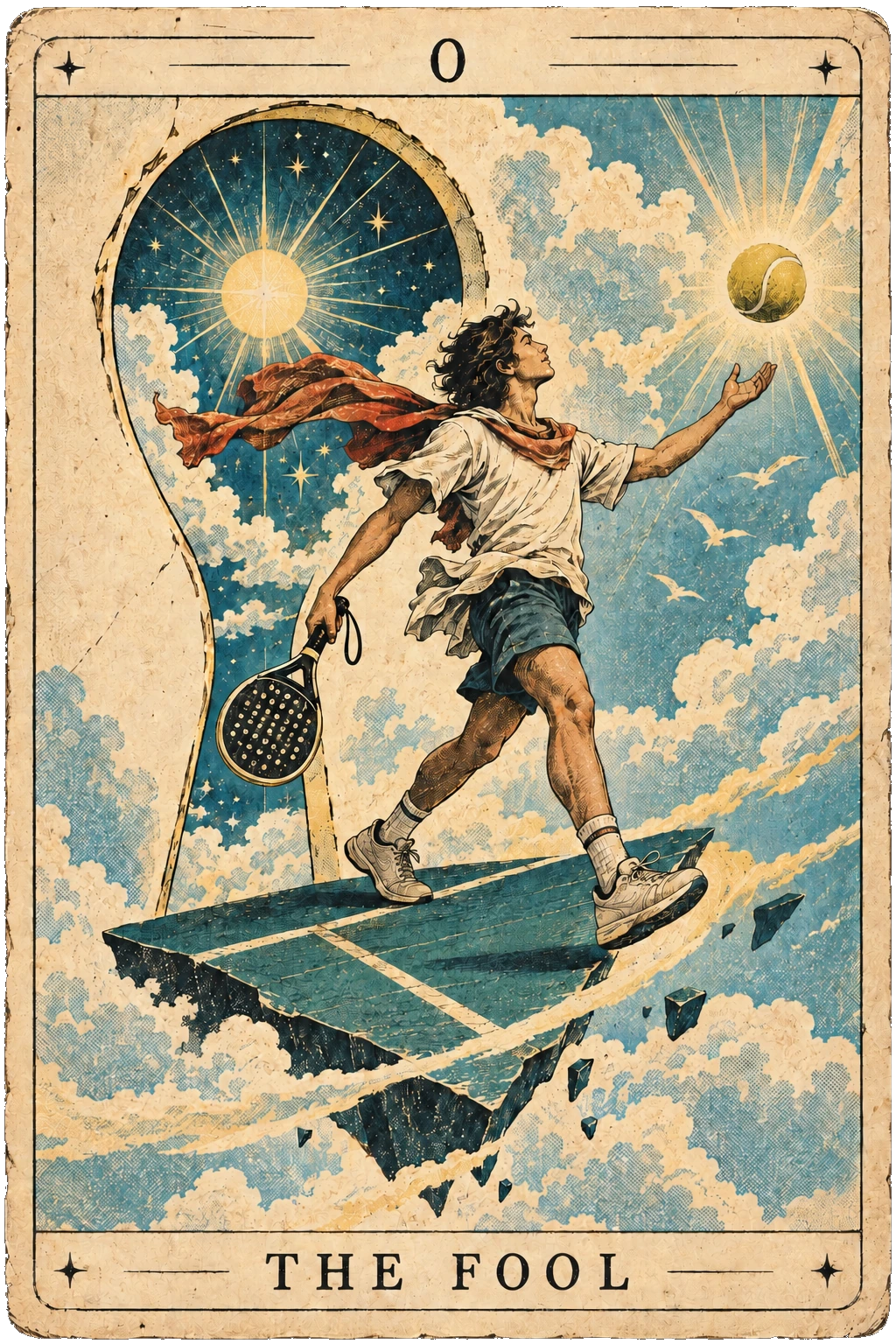
The traveller in the Fool's card has one foot leaving a fragment of court. The next foothold is not shown. A racket travels with them, but it cannot make the air solid. For a moment the whole image belongs to the decision to step, before anyone knows what kind of landing there will be.
You might know that instant from the edge of a padel court: a first match, a new partner, a group whose level seems beyond yours. The other three players are waiting. It would be easy to call the anxiety evidence that you are not ready, although nobody has asked you to arrive already accomplished.
At the first serve, an old plan may not help. You might misread the glass, stand too close to your partner, or be surprised by how quickly four bodies make decisions in a small space. The point ends. Nobody asks whether your entrance was worthy of a story; another ball is already being offered. That ordinary continuation is part of the card's generosity.
Beginning well does not mean looking fearless. The Fool can ask where your partner prefers to stand, try a ball without needing it to be beautiful, and laugh when the first attempt goes somewhere unexpected. Curiosity keeps the senses open. There is room to notice the lines, the glass and the people who will share the game with you.
The same openness can become carelessness if every warning is treated as an insult to freedom. A call from your partner matters. So does noticing when an experiment has become a repeated mistake. There is another way to refuse the step: keep collecting lessons and better equipment until you can pretend the first match will never be a first match.
The next foothold is still outside the picture. What would an attentive first step look like from where you stand?