On the way home from a padel match, explanations crowd the missed ball. Your partner was too far forward. The opponent read the glass. You should have followed the advice someone gave you last week. You can ask three more people tomorrow and receive three more answers.
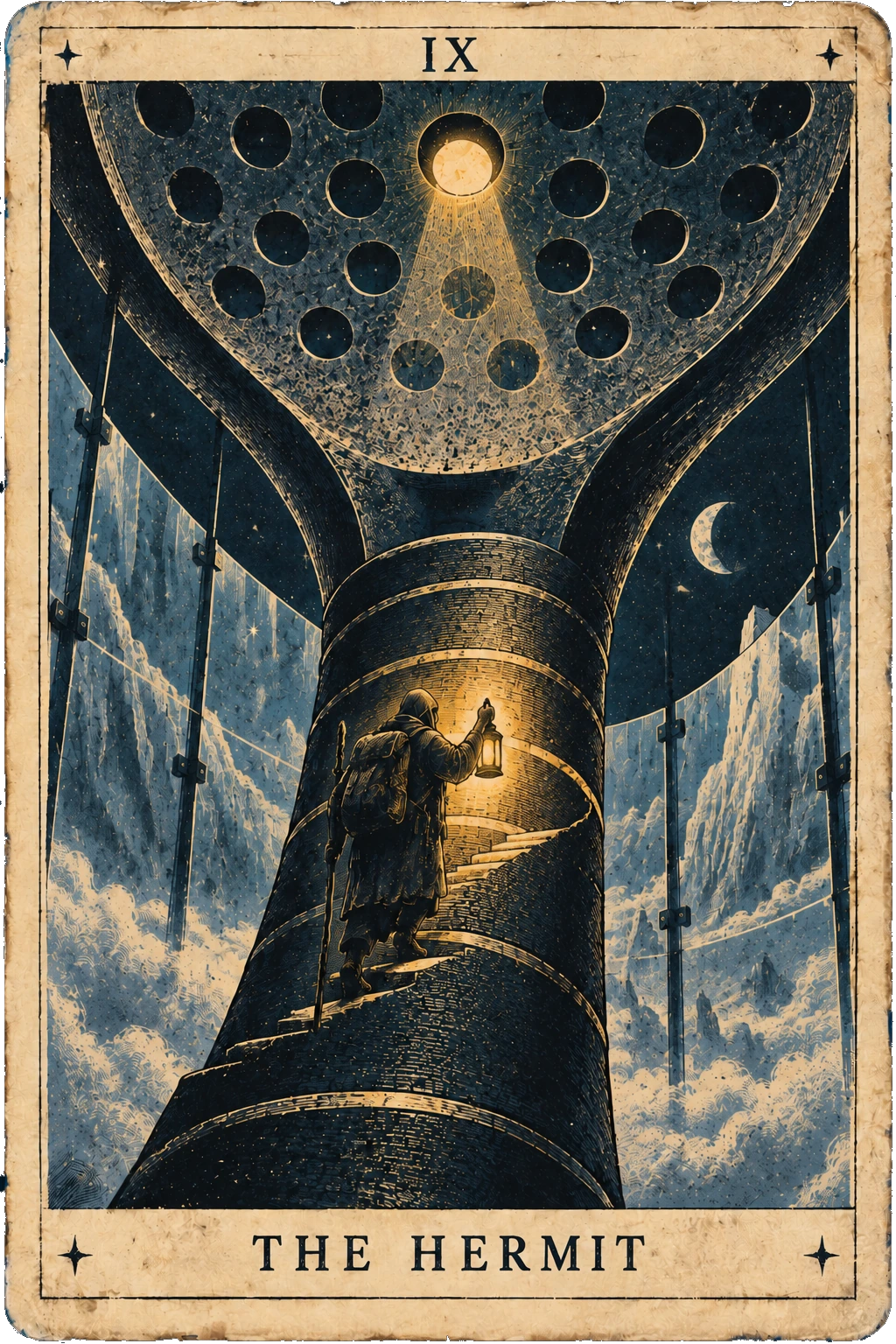
The Hermit suggests that the next useful sound may be no sound at all. A vast racket becomes a black mountain in the card, its holes dark moons. Far below, a tiny seeker carries an amber lamp between cliffs and water. The light reaches only a small distance; there is no audience waiting for a revelation at the summit.
That scale is a relief. The seeker is not required to illuminate the entire mountain tonight. You might leave the match with one workable question: did the pair stop calling when the score tightened? There will be time to test what you find.
A little solitude can let a match return to its actual size. Perhaps one choice recurred. Perhaps the result supplied too little evidence for the conclusion you were about to make. You could practise alone to test what you noticed, then bring a clearer question to a coach or partner. The lamp need not contain the answer in order to show where to stand next.
That return matters. A player who has worked something out privately can come back with a simpler request: “Can we watch what happens when I leave that ball?” It invites another perspective without surrendering the discernment gained in quiet. The Hermit is not a permanent address.
The pause can also become a disappearance. You leave after every difficult game without speaking, or replay the same mistake until reflection turns into a private trial. Solitude is no longer helping you see when it is used to keep every other person outside the account. A doubles point will eventually need another player.
What becomes audible when the crowd of advice falls away? Keep the answer small enough to carry back onto court.