“It was the bounce.” “I moved too late.” Both partners are speaking about the same lost padel point, and neither has seen all of it. Justice begins before either account is made into a case against the other.
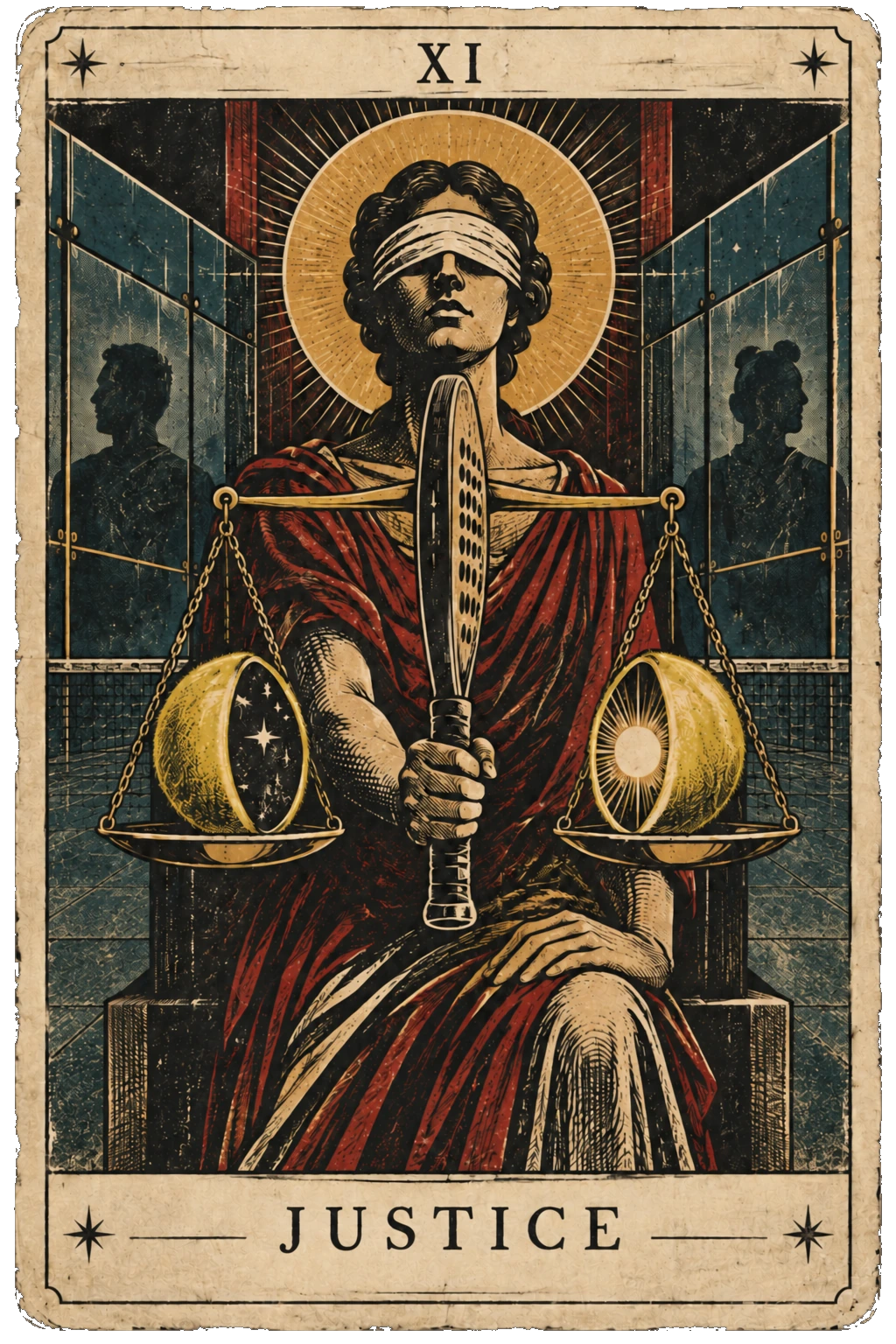
The card gives the question a stern form. A blindfolded figure sits between dark glass planes. A racket shaft rises like a blade; luminous vessels balance on either side. The image asks for separation and proportion: what was observed, what has been inferred, and how much weight should one moment be allowed to hold?
A point may include a fortunate contact, an opponent's good choice, your call, your partner's movement and a decision made two balls earlier. “We were unlucky” might be partly true and still hide an adjustment. “It was all my fault” might sound generous while erasing the rest of the rally. An accurate account is more useful than either defence.
You can own the late movement without turning yourself into a late player forever. You can ask what your partner saw before assigning a motive to them. Patterns become easier to change when they are named as patterns, rather than filed as evidence of someone's worth.
A scale can become a ledger too. If every miss is entered against a person, no amount of careful language will make the conversation fair. Forgiving everything without looking also abandons the pair to repetition. The Wheel reminds us that control is partial; Justice insists that partial responsibility is still real.
A useful review might begin with a description both players can check: “We lost three points when the middle ball went uncalled.” It leaves room to ask why, and room for both players to propose a different arrangement. That is more demanding than naming a culprit and more generous than deciding nothing happened.
Before the next match, an account both players can recognise will serve them better than a verdict either must defend against.