
“Let's decide early.” “I need to see the rally first.” The two padel partners have tried alternating who leads. On one point they commit before either has seen enough; on the next they hesitate until neither can act. Taking turns has left both of their best qualities unused.
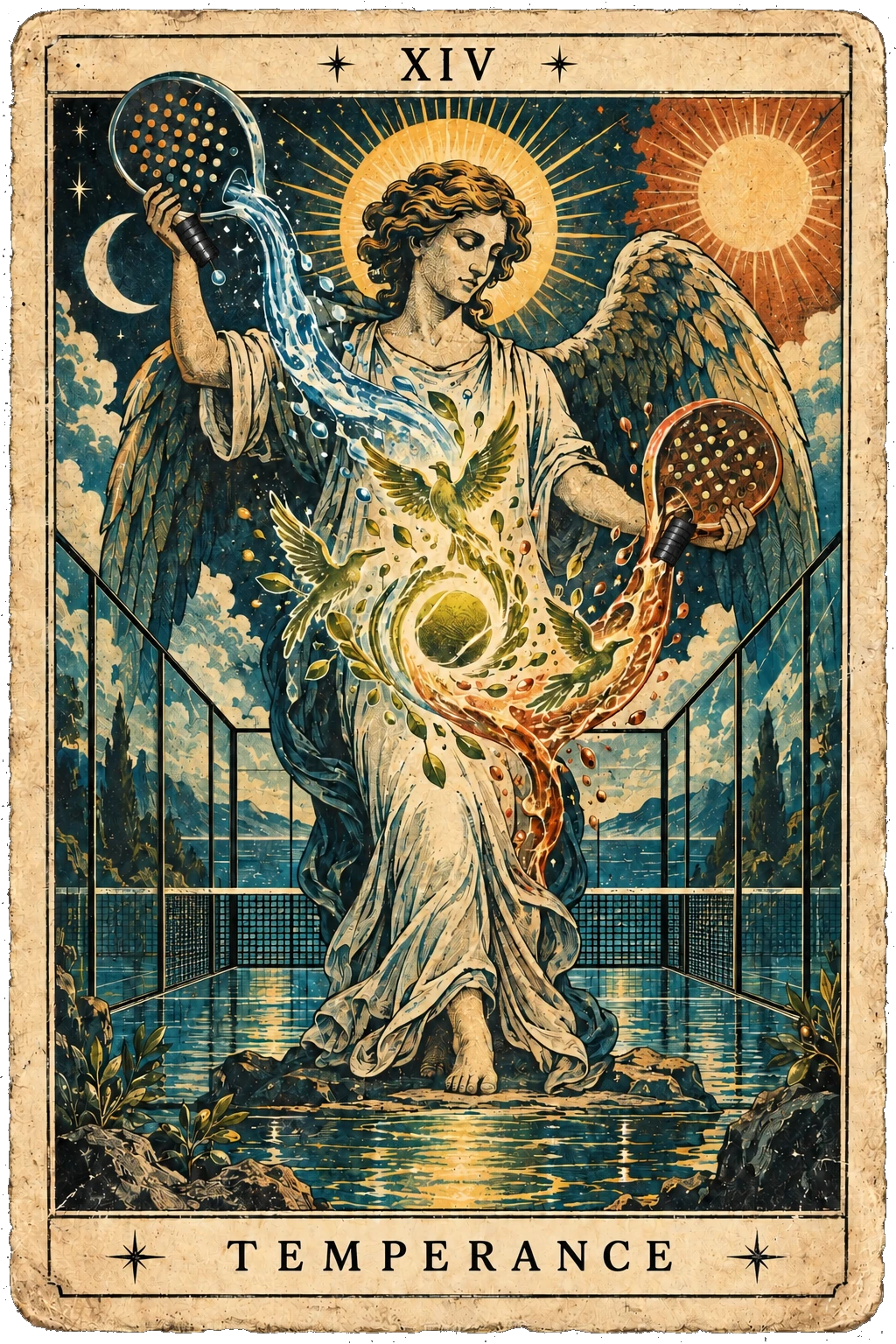
Temperance asks them to make something neither could play alone. In the card, a winged figure conducts bright streams and an orb between two rackets shaped as vessels. Sun and water occupy different sides; the flow does not erase the difference. The image holds an impossible exchange.
A quicker player may learn to leave space for a partner's patient construction. The patient player may recognise the moment when the other's appetite is exactly what the point needs. Recovery after a sharp exchange can take a similar shape: acknowledge the feeling, change the pace, retain the shared intention. The result is more alive than a permanent fifty-fifty division. It takes repeated listening, because the useful mixture at one score may not be the useful mixture at another.
An obsession with balance can make every difference sound like a threat. Nobody is allowed to be decisive; each contribution must be equal even when the ball asks for something uneven. The vessels in the image keep pouring. If all motion were arrested in the name of perfect moderation, there would be no new mixture.
A partnership might need one person to carry more of a difficult stretch while the other recovers confidence. That arrangement can be generous if it is named and revisited. When it hardens into a permanent role, the exchange has stopped. Temperance requires both players to remain capable of receiving as well as giving.
Which two parts of your game have you kept apart because you have not yet found a way for them to affect each other?